

 English
 русский
What Is Ring Forging
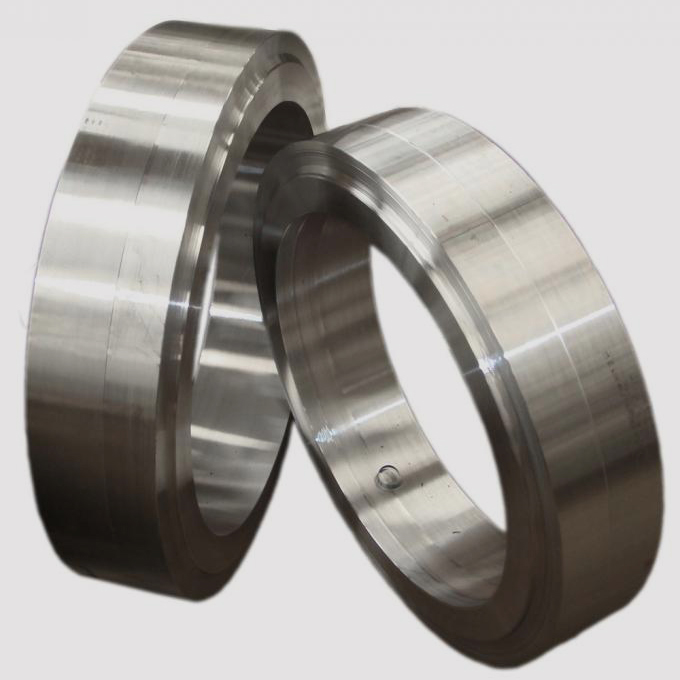
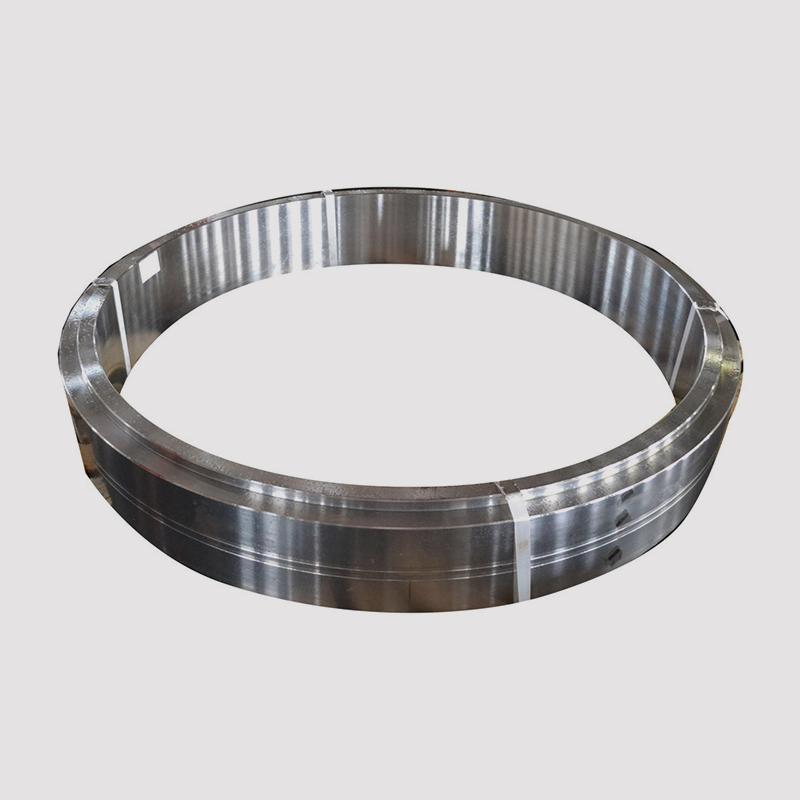
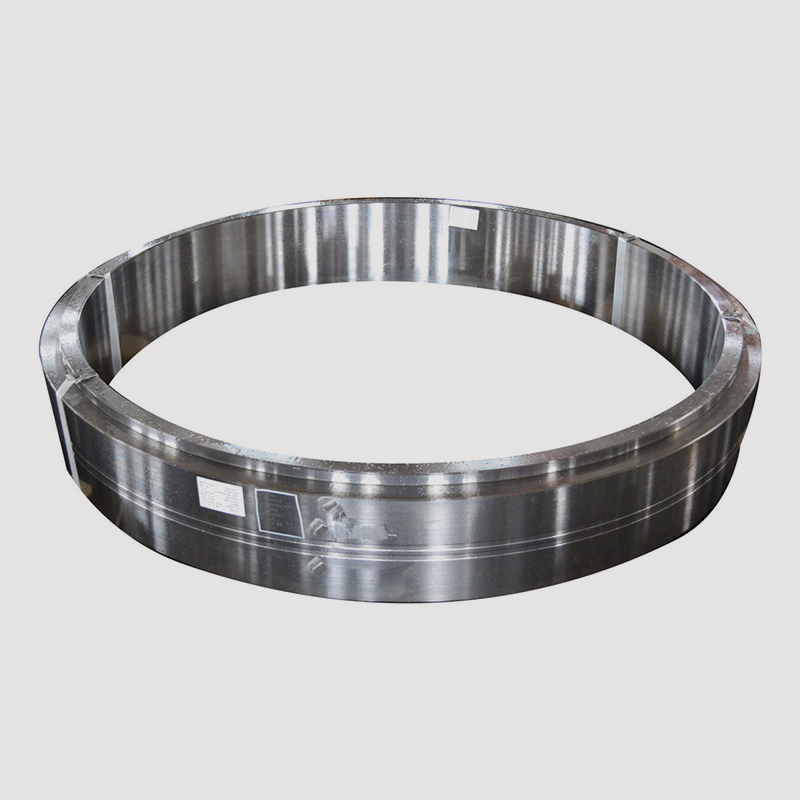
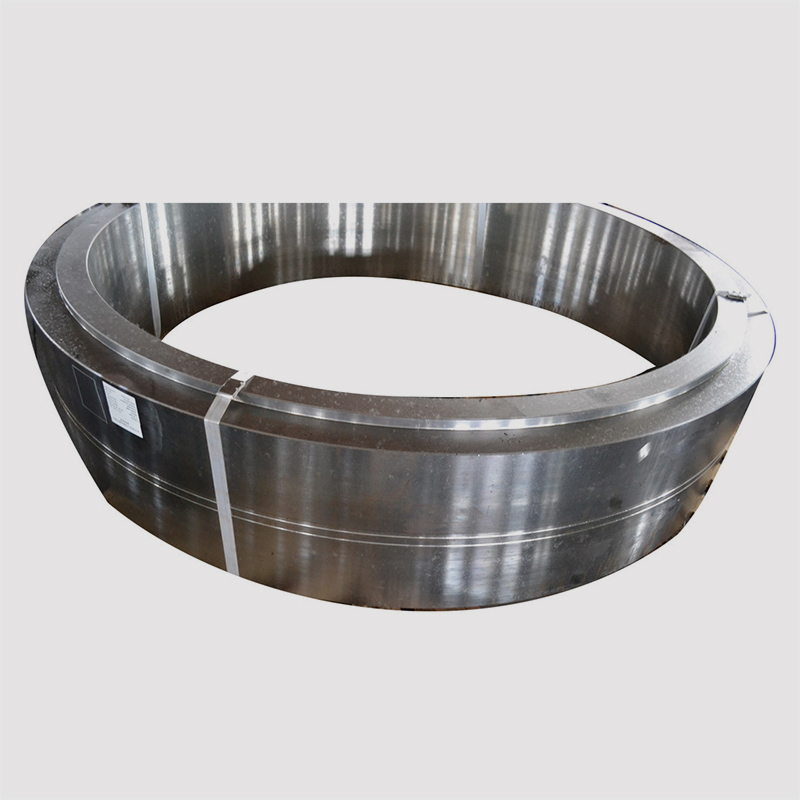
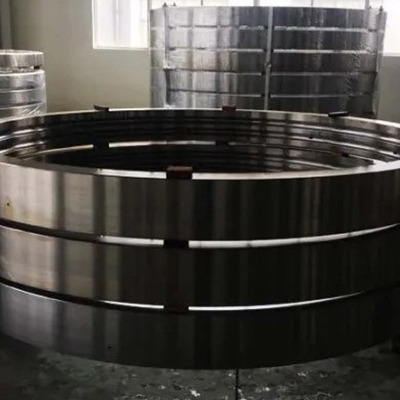
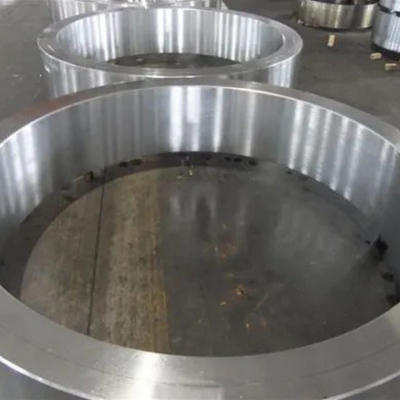
Ring forging is a metal-shaping process that produces seamless, circular components by deforming a pierced metal blank under high pressure until it takes the shape of a ring. Unlike rings cut from plate or rolled from strip and welded at a seam, forged rings have no weld joints, which gives them a continuous, uninterrupted grain structure that follows the circumference of the part.
The process typically starts with a round steel billet that is upset (compressed to increase diameter and reduce height), then pierced to create a center hole, forming a donut-shaped preform. This preform is then expanded and rolled — either by hand forging on an open die press or by rotary ring rolling — until it reaches the target diameter, wall thickness, and height. Because the grain flow is oriented circumferentially rather than being cut across, forged rings deliver higher radial and tangential strength than plate-cut or machined rings of the same alloy.
Ring Forging Process Types
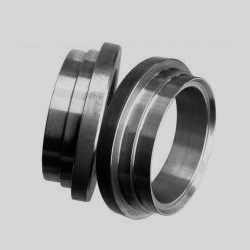
Most forged rings are produced through one of three related methods, each suited to different size ranges and production volumes:
- Open die (hand) forging — a technician manipulates the preform between flat or simple-shaped dies on a hydraulic press, gradually working it into a ring shape. Best suited to large-diameter, low-volume, or custom rings up to several meters across.
- Closed die (impression die) forging — the preform is pressed into a cavity that matches the final ring profile in a single or few strokes, producing near-net-shape rings with tighter tolerances and less machining.
- Seamless rolled ring forging — the pierced preform is placed over an idler roll and squeezed against a driven roll, causing the ring to grow in diameter while its wall thickness decreases, similar to how a rolling pin flattens dough. This is the dominant method for medium-to-large rings used in bearings, flanges, and gears.
Rolled ring forging is often treated as a distinct category from open die and closed die forging because the ring grows on a mandrel through continuous rolling rather than repeated die strikes, giving it a more uniform, fine-grained microstructure and tighter diameter control.
Open Die Forging vs Closed Die Forging
The choice between open die and closed die forging comes down to part size, tolerance requirements, and production volume.
| Factor | Open Die Forging | Closed Die Forging |
|---|---|---|
| Tooling cost | Low, uses generic flat/simple dies | Higher, requires part-specific die sets |
| Dimensional tolerance | Looser, more machining allowance needed | Tighter, closer to net shape |
| Best production volume | Low volume, custom/one-off parts | Medium to high volume |
| Practical size limit | Can exceed several meters in diameter | Limited by press and die capacity |
Comparison of open die and closed die forging across common selection criteria.
In ring production specifically, open die methods are usually reserved for oversized or short-run rings, while closed die and rolled ring processes handle the bulk of standard bearing races, flanges, and gear blanks where repeatable dimensions matter more than one-off flexibility.
Hot Forging vs Cold Forging
Most seamless rolled rings are hot forged, meaning the billet is heated above its recrystallization temperature — typically 1,900–2,300°F (1,040–1,260°C) for carbon and alloy steels — before shaping. Heating lowers the material's resistance to deformation, allowing large rings to be formed without cracking and letting the grain structure recrystallize as it deforms, which removes internal stresses and improves ductility.
Cold forging, by contrast, shapes metal at or near room temperature. It produces a smoother surface finish and tighter tolerances without secondary machining, and it work-hardens the material, increasing strength. However, cold forging requires significantly higher forming force and is generally limited to smaller rings and softer alloys such as low-carbon steel or aluminum, since larger sections or harder alloys are prone to cracking without heat.
- Hot forging suits large rings, high-alloy steels, and applications where maximum toughness and fatigue resistance are priorities, such as wind turbine bearings and pressure vessel flanges.
- Cold forging suits smaller precision rings, such as bearing races and automotive components, where surface finish and dimensional accuracy reduce downstream machining costs.
Forged Rings vs Seamless Rolled Rings
"Forged ring" is the broad category; "seamless rolled ring" is a specific type of forged ring produced by the rotary rolling method described above. In practice, when people compare the two terms they're usually asking how rolled rings differ from rings made by open die hand forging or from other manufacturing routes like ring rolling versus plate rolling and welding, or machining from a solid disc.
Compared to plate-rolled-and-welded rings, seamless rolled rings avoid the weld seam entirely, eliminating a common failure point under cyclic or high-pressure loads. Compared to rings machined from a solid forged disc or bar stock, seamless rolled rings waste far less material, since the center is pierced out early in the process rather than cut away, and their grain flow follows the ring's circumference rather than being interrupted by machining across the grain.
Compared to open die hand-forged rings, seamless rolled rings offer more consistent wall thickness and roundness because the rolling process is continuous and mechanically controlled, whereas hand forging relies on operator skill to maintain uniformity — an advantage that becomes more pronounced as production volume increases.
Forged Ring Applications
The grain continuity and directional strength of forged rings make them the preferred choice wherever a component must resist radial or tangential loads, fatigue, or pressure cycling:
- Bearings — inner and outer races for ball and roller bearings used in wind turbines, mining equipment, and industrial gearboxes.
- Flanges — pipe and pressure vessel flanges in oil and gas, petrochemical, and power generation plants, where a seamless structure resists internal pressure without a weld-line weak point.
- Gears and gear blanks — ring gears for wind turbine gearboxes, construction machinery, and marine propulsion systems.
- Aerospace components — jet engine casings and rotor rings, where high strength-to-weight ratio and fatigue resistance are critical.
- Slewing rings — large-diameter rotational connections for cranes, excavators, and wind turbine yaw and pitch systems.
Material selection typically follows the application: carbon and low-alloy steels for general industrial bearings and flanges, stainless steel for corrosive or high-temperature environments, and nickel-based or titanium alloys for aerospace and high-performance turbine applications.