

 English
 русский
What Determines Load Capacity and Fatigue Life in a Steel Eccentric Shaft
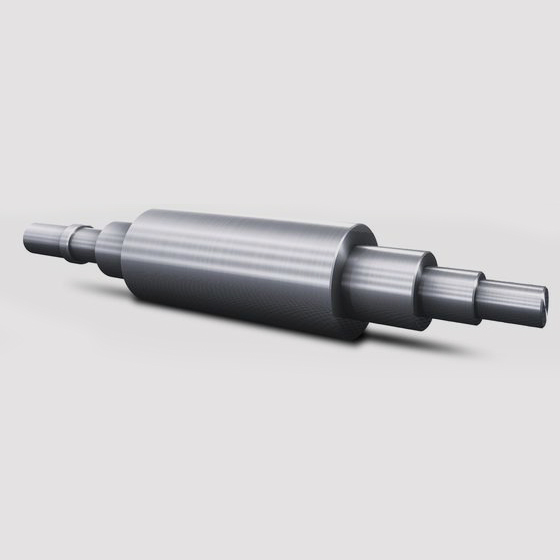
A steel eccentric shaft transmits rotating force off-center from its axis, and the fatigue life of that shaft depends far more on stress concentration at the transition zones than on the raw tensile strength of the steel itself. The step-down sections where the eccentric throw meets the main shaft diameter are where cyclic bending stress concentrates, and a sharp-cornered transition can reduce fatigue life by half or more compared to a properly radiused fillet, even when both shafts use identical material.
Shaft diameter and eccentricity together determine bending moment under load, but the relationship isn't linear — doubling the eccentric throw roughly doubles the bending stress at a given speed and load, while increasing shaft diameter reduces stress by the cube of the diameter change. This is why vibrating screen and crusher manufacturers tend to oversize the main shaft diameter well beyond what static load calculations alone suggest, since the shaft sees millions of stress reversal cycles over its service life rather than a single static load.
Surface finish on the bearing journals also has a measurable effect on fatigue performance. A ground and polished journal surface, typically finished to 0.4 micrometers Ra or better, resists crack initiation far longer than a rougher turned finish, since surface scratches and tool marks act as micro-stress-risers under repeated cyclic loading. On heavily loaded shafts running continuous duty, this difference in surface finish can account for a meaningful portion of the total variance in service life between otherwise identical shaft designs.
Eccentricity, Throw, and How They Affect Vibration Amplitude
Eccentric throw — the offset distance between the shaft's main axis and the eccentric section's center — directly sets the stroke or amplitude of whatever mechanism the shaft drives, whether that's a vibrating screen deck, a punch press ram, or a reciprocating pump. A larger throw produces greater amplitude at a given rotational speed, but also increases the centrifugal force generated by the rotating eccentric mass, which places higher demands on the bearings and supporting structure.
Matching throw to application is a balancing act rather than a simple "bigger is better" decision. Vibrating screens processing fine material generally use a smaller throw at higher frequency to achieve efficient stratification without over-stressing the screen media, while screens handling coarse, heavy material often use a larger throw at lower frequency to generate enough force to move dense particles across the deck. Getting this balance wrong shows up quickly as either poor screening efficiency or premature wear on bearings and structural mounts.
- Small throw, high frequency: Fine material screening, precise stratification
- Large throw, low frequency: Coarse or heavy material handling
- Symmetrical dual eccentric: Balanced reciprocating motion, reduced vibration transfer to frame
- Adjustable eccentric collar: Applications requiring stroke tuning without shaft replacement
Material Grade and Heat Treatment Options Compared
Material selection for a steel eccentric shaft generally comes down to a tradeoff between fatigue resistance, machinability, and cost. Medium-carbon alloy steels dominate the mid-duty range, while higher-alloy grades with nickel and chromium content are reserved for shafts running under sustained heavy cyclic load or requiring greater wear resistance at the bearing journals.
| Material/Treatment | Best Suited For | Tradeoff |
|---|---|---|
| 45# medium-carbon steel | General-duty vibrating equipment | Lower fatigue limit under heavy cyclic load |
| 42CrMo alloy steel | Heavy-duty crushers, high-cycle screens | Higher material and machining cost |
| Induction-hardened journal | High-wear bearing contact areas | Added processing step and cost |
| Through-hardened and tempered | Shafts needing uniform core strength | Lower surface hardness than case-hardened options |
Comparison of common steel eccentric shaft material and treatment options by suited application and tradeoff.
Bearing Fit, Balancing, and Installation Tolerances
Bearing journal tolerance is one of the most frequently underestimated factors in eccentric shaft performance. A journal machined slightly oversized relative to the bearing's inner race creates excessive interference fit, generating heat and accelerating bearing wear, while an undersized journal allows the inner race to creep against the shaft under load, wearing a groove into the journal surface over time. Most heavy-duty applications specify journal tolerances within a few microns to avoid both failure modes.
Dynamic balancing before installation matters more for eccentric shafts than for straight rotating shafts, since the offset mass inherently creates an unbalanced rotating force even when perfectly manufactured. Counterweights are typically sized and positioned during the design phase to offset the eccentric mass, but manufacturing tolerances mean each finished shaft still needs individual balancing verification, usually to a specified residual unbalance grade, before it goes into service in equipment running at higher rotational speeds.
Alignment during installation is equally critical. A shaft installed with even a small angular misalignment relative to its bearing housings introduces additional cyclic bending stress on top of the stress the eccentric design already generates, which can dramatically shorten service life. Laser alignment tools have largely replaced dial-indicator methods in modern installation practice because they catch angular misalignment more reliably across the full length of longer shafts.
Common Failure Modes and How to Prevent Them
Fatigue cracking at fillet transitions is the most common failure mode for a heavily loaded steel eccentric shaft, and it typically starts as a microscopic crack that propagates slowly over thousands of operating hours before becoming visible or causing catastrophic failure. Regular inspection using magnetic particle or dye penetrant testing at known high-stress zones catches these cracks well before they reach a critical size, especially on shafts running in continuous heavy-duty service.
Bearing journal wear from inadequate lubrication is the second most common cause of premature shaft replacement, and it's largely preventable through consistent lubrication scheduling and monitoring oil or grease condition for contamination. Water or fine particulate contamination in the lubricant accelerates journal wear significantly faster than clean lubricant under the same load, which is a particular concern in outdoor crushing and screening applications exposed to dust and moisture.
Corrosion at the shaft surface, especially in humid or chemically aggressive environments, can also initiate fatigue cracking by creating surface pitting that acts as a stress concentrator similar to a manufacturing defect. Protective coatings or corrosion-resistant material upgrades are generally worth the added cost in applications like wastewater screening or coastal aggregate processing, where untreated carbon steel shafts can show measurable pitting within a few years of service.