

 English
 русский
Forged Steel Ring Manufacturing Process
Forged steel rings are produced through a process called ring rolling, which starts with a solid steel billet and ends with a seamless, circular ring with a continuous, uninterrupted grain structure running around its circumference. That seamless grain flow is the defining advantage over a ring cut or welded from plate, since it eliminates the weld seam or cross-grain cut that would otherwise become the weakest point under load.
- Billet cutting and heating: A steel billet is cut to a calculated starting weight and heated in a furnace to forging temperature, typically between 1,100°C and 1,250°C depending on the alloy.
- Upsetting: The heated billet is compressed to increase its diameter and reduce its height, forming a short, thick cylindrical shape.
- Piercing: A punch drives through the center of the upset billet to create a hole, forming a donut-shaped preform called a "doughnut."
- Ring rolling: The pierced preform is placed over a mandrel roll and against a main roll, which progressively squeezes and rotates the ring, reducing wall thickness while increasing diameter until the ring reaches its target dimensions.
- Sizing and cooling: The rolled ring is checked against target dimensions, trimmed if needed, and allowed to cool under controlled conditions to avoid warping or residual stress.
- Heat treatment and machining: The ring goes through heat treatment to achieve its final mechanical properties, then any machining needed to reach final drawing dimensions.
Open Die vs. Closed Die Forged Steel Rings
Open die forged steel rings are shaped using flat or simple-contour dies that don't fully enclose the workpiece, which is the standard approach for ring rolling and gives flexibility to produce a wide range of ring diameters and cross-sections without investing in a dedicated die set for each size. This makes open die forging, including ring rolling, well suited to large or custom rings produced in lower volumes.
Closed die forged steel rings, by contrast, are formed inside a die that fully encloses the desired cross-sectional profile, producing a ring with more complex geometry — such as an integral flange or contoured cross-section — in a single forging operation with tighter as-forged tolerances. Closed die forging requires a dedicated die for each specific ring design, which makes it more cost-effective at higher production volumes where the tooling cost is spread across many parts, while open die/ring rolling remains the more flexible and economical choice for custom or lower-volume ring orders.
Large Diameter and Heavy Duty Forged Steel Rings
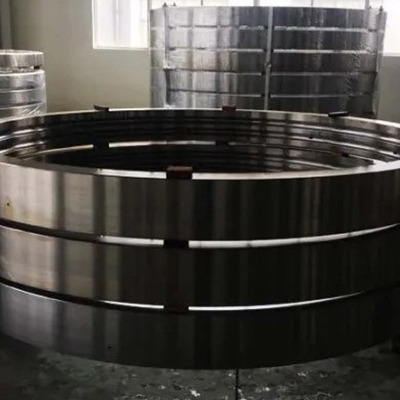
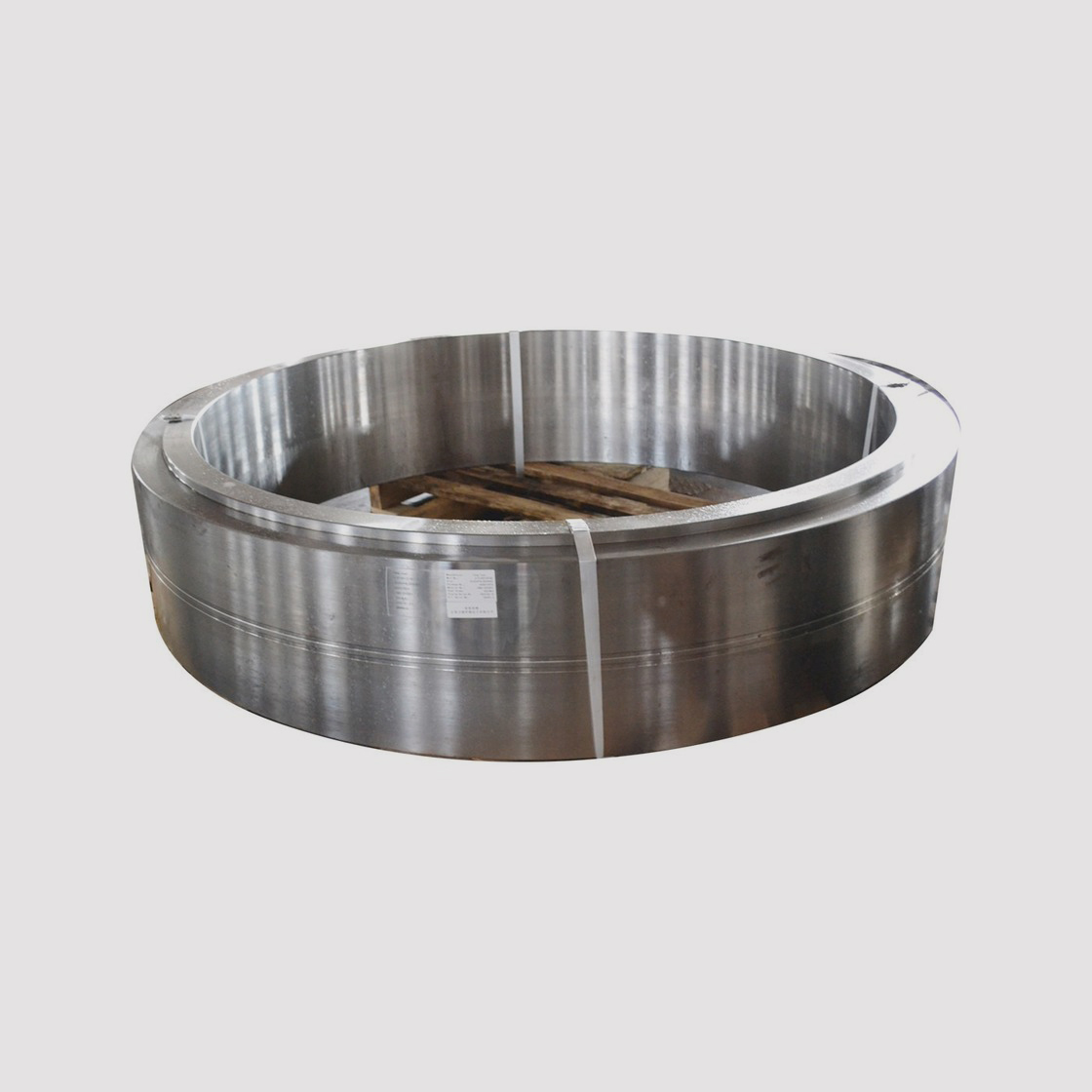
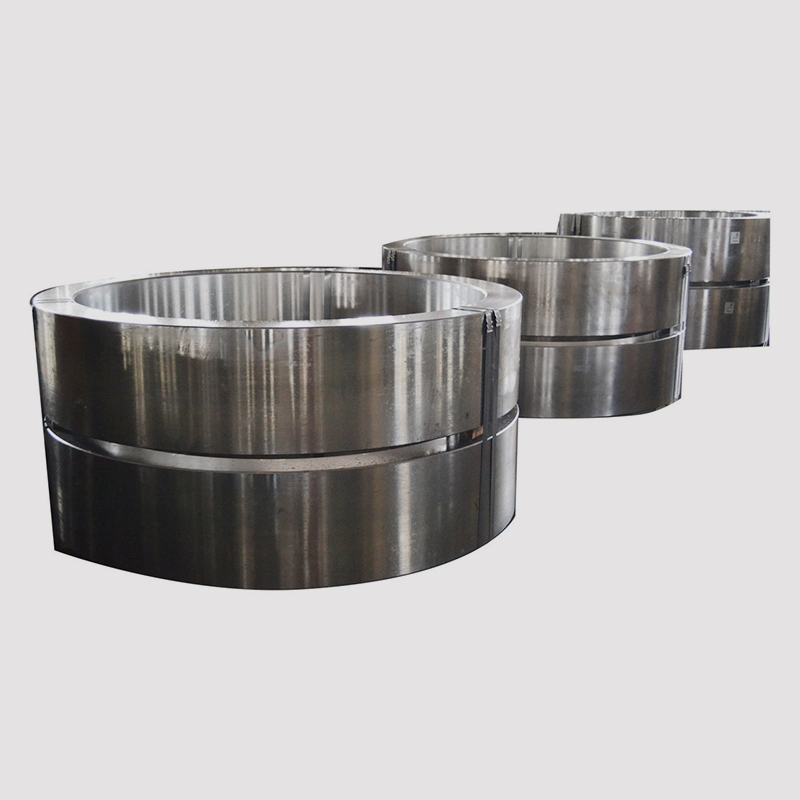
Large diameter forged steel rings, often exceeding a meter or more across, are used in applications like wind turbine flanges, slewing bearing races, pressure vessel components, and large industrial gearboxes, where the ring needs to carry substantial structural or rotational load. Producing rings at this scale requires ring rolling mills with sufficient roll separating force and mandrel capacity, since larger rings demand proportionally greater forging force to achieve the same wall reduction as a smaller ring.
Heavy duty forged steel rings are specified not just by diameter but by cross-sectional thickness and alloy grade suited to high-load service — wind energy and heavy machinery applications in particular call for rings that combine large size with high-strength alloy steel and rigorous heat treatment, since a failure at that scale carries far greater consequences than a smaller component failure.
Custom Forged Steel Rings
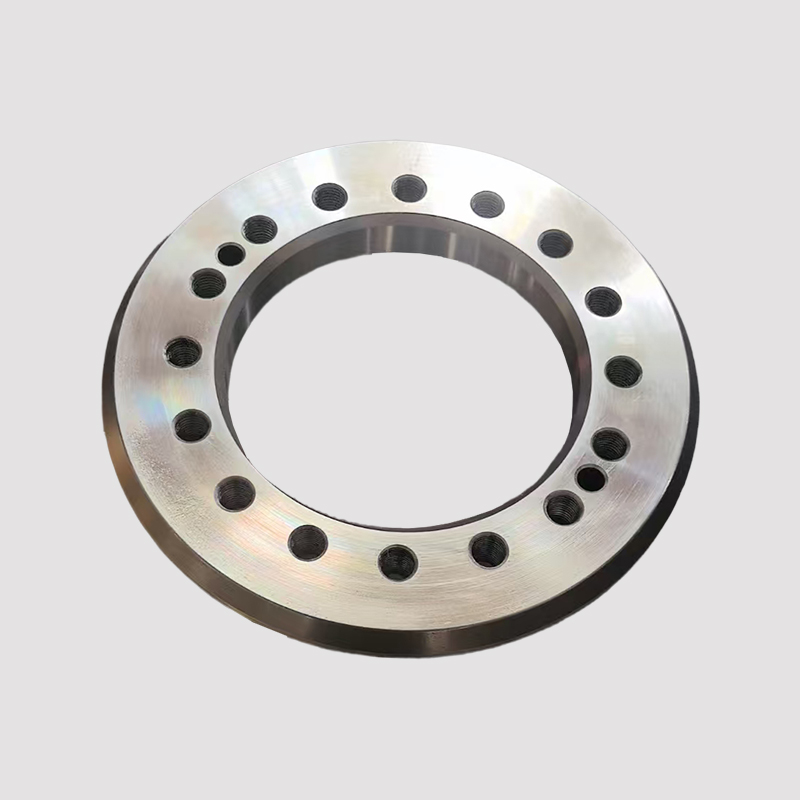
Custom forged steel rings are produced to a specific drawing rather than a standard catalog size, with diameter, wall thickness, height, and alloy selected to match the customer's application. Ring rolling's process flexibility makes custom sizing relatively straightforward compared to processes that require dedicated tooling for each dimension — the same mill can roll a wide range of diameters and cross-sections simply by adjusting the preform size and roll settings.
Beyond dimensional customization, custom orders often specify particular mechanical property requirements, non-destructive testing (ultrasonic or magnetic particle inspection), and material certification to match the ring's intended service — details worth confirming with the manufacturer at the quoting stage rather than after production begins.
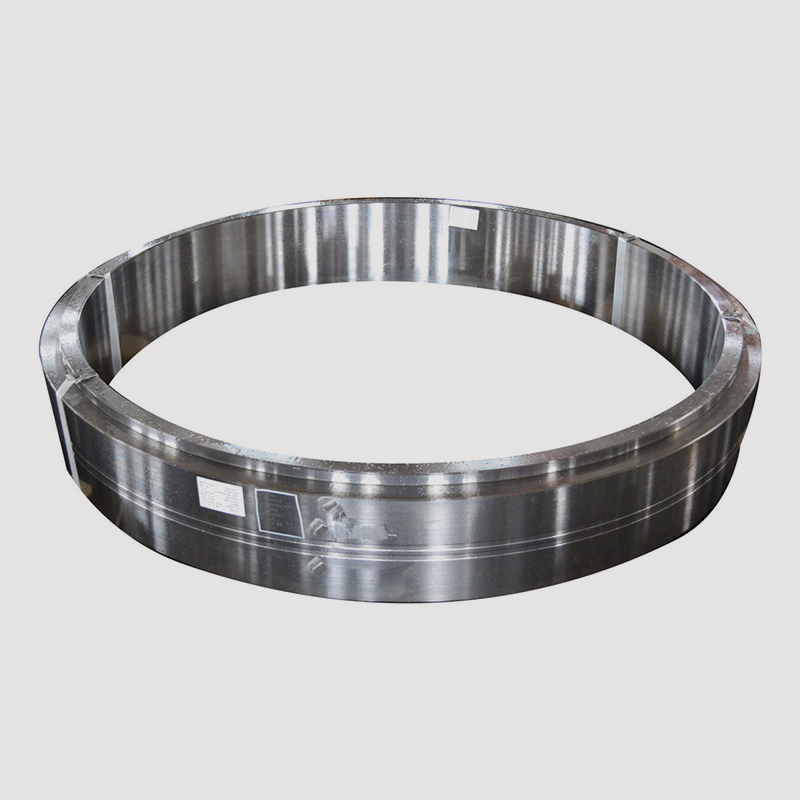
Forged Steel Rings Heat Treatment
Heat treatment after forging is what develops a ring's final mechanical properties — as-forged material alone typically doesn't meet the strength, toughness, or hardness specification the application requires. Common heat treatment processes for forged steel rings include:
- Normalizing: Heating above the critical temperature followed by air cooling, used to refine grain structure and relieve internal stress from forging.
- Quenching and tempering: Rapid cooling (quenching) to achieve high hardness, followed by reheating to a lower temperature (tempering) to restore toughness and reduce brittleness — the standard treatment for higher-strength alloy steel rings.
- Annealing: Slow, controlled cooling from an elevated temperature, used to soften the material for easier subsequent machining.
- Stress relieving: A lower-temperature treatment focused specifically on reducing residual stress from forging and machining without significantly altering hardness.
Ring geometry adds a practical wrinkle to heat treatment that solid parts don't face: because rings are thin relative to their diameter, uneven heating or cooling can distort roundness, so heat treatment furnaces and quench fixtures for large rings are often designed specifically to support the ring evenly and control temperature uniformity around its circumference.
Alloy Steel Forged Rings
Alloy steel forged rings incorporate elements like chromium, molybdenum, nickel, or vanadium beyond plain carbon steel's composition, improving strength, hardenability, or toughness for demanding applications. Common alloy grades for forged rings include 42CrMo (a chromium-molybdenum steel widely used for gears and high-strength structural rings), 34CrNiMo6 for very high-strength applications like wind turbine main shafts and bearing rings, and various AISI 41xx-series steels for general high-strength forged components.
Grade selection generally comes down to balancing required strength and toughness against cost and machinability — higher-alloy grades cost more and can be more difficult to machine, so specifying more alloy content than the application actually needs adds expense without a corresponding performance benefit.
Precision Forged Steel Rings
Precision forged steel rings are produced to tighter as-forged dimensional tolerances than standard ring rolling typically achieves, reducing the amount of subsequent machining needed to reach final drawing dimensions. This is accomplished through more tightly controlled preform sizing, roll pressure, and process monitoring during the ring rolling operation itself, rather than relying on generous machining stock to correct dimensional variation after forging.
The main benefit of precision forging is material and machining time savings — a ring that comes off the mill closer to its final dimensions requires less material to be removed and less machine time to finish, which matters most on higher-volume programs where that savings compounds across many parts.