

 English
 русский
Forged Steel Ring Manufacturing Process
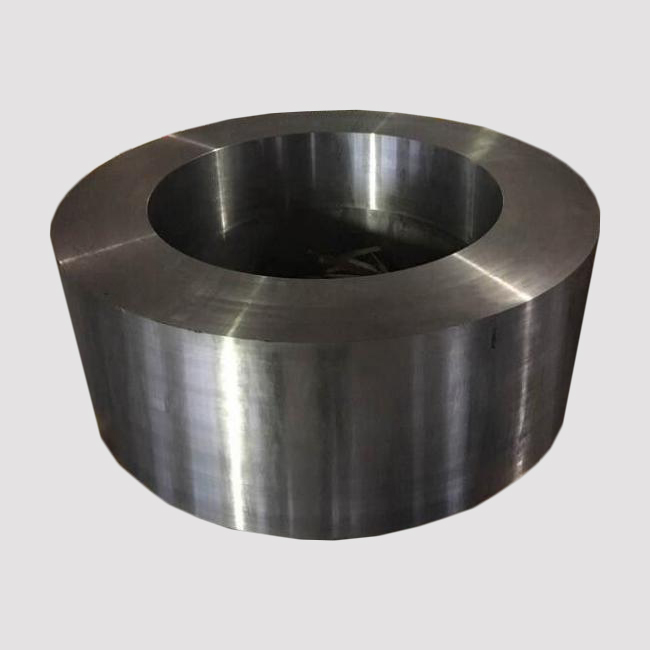
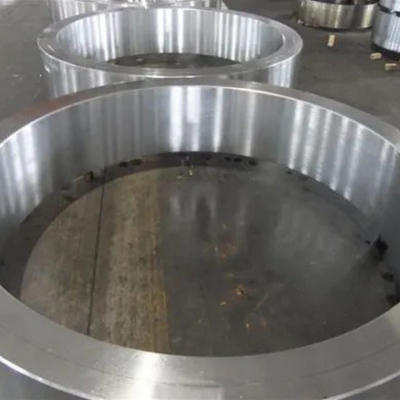
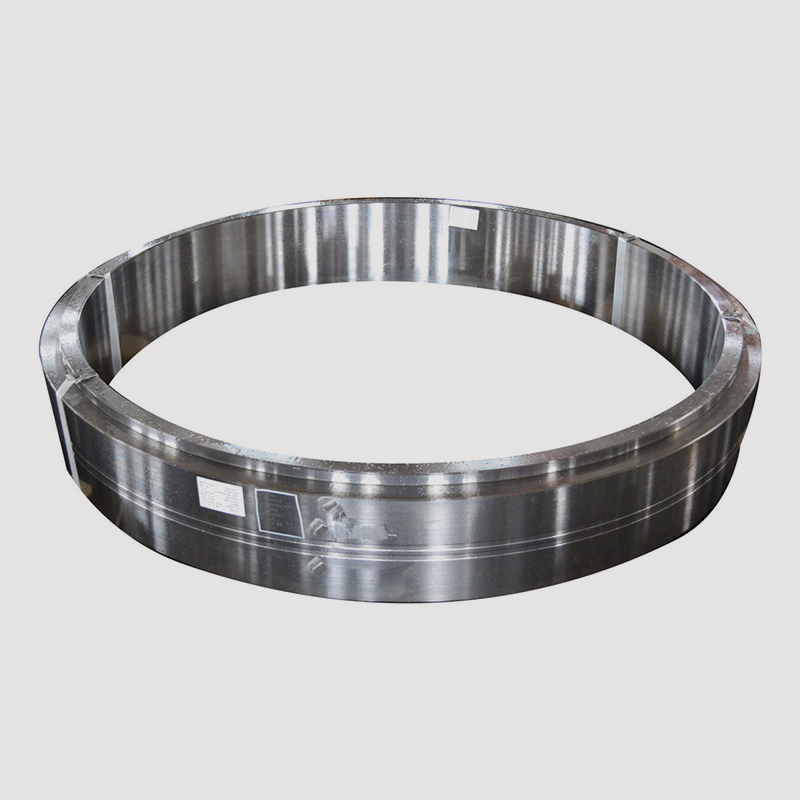
Forged steel rings are produced through a process called ring rolling, which starts with a solid steel billet and ends with a seamless, circular ring with a continuous, uninterrupted grain structure running around its circumference. That seamless grain flow is the defining advantage over a ring cut or welded from plate, since it eliminates the weld seam or cross-grain cut that would otherwise become the weakest point under load.
- Billet cutting and heating: A steel billet is cut to a calculated starting weight and heated in a furnace to forging temperature, typically between 1,100°C and 1,250°C depending on the alloy.
- Upsetting: The heated billet is compressed to increase its diameter and reduce its height, forming a short, thick cylindrical shape.
- Piercing: A punch drives through the center of the upset billet to create a hole, forming a donut-shaped preform called a "doughnut."
- Ring rolling: The pierced preform is placed over a mandrel roll and against a main roll, which progressively squeezes and rotates the ring, reducing wall thickness while increasing diameter until the ring reaches its target dimensions.
- Sizing and cooling: The rolled ring is checked against target dimensions, trimmed if needed, and allowed to cool under controlled conditions to avoid warping or residual stress.
- Heat treatment and machining: The ring goes through heat treatment to achieve its final mechanical properties, then any machining needed to reach final drawing dimensions.
Open Die vs. Closed Die Forged Steel Rings
Open die forged steel rings are shaped using flat or simple-contour dies that don't fully enclose the workpiece, which is the standard approach for ring rolling and gives flexibility to produce a wide range of ring diameters and cross-sections without investing in a dedicated die set for each size. This makes open die forging, including ring rolling, well suited to large or custom rings produced in lower volumes.
Closed die forged steel rings, by contrast, are formed inside a die that fully encloses the desired cross-sectional profile, producing a ring with more complex geometry — such as an integral flange or contoured cross-section — in a single forging operation with tighter as-forged tolerances. Closed die forging requires a dedicated die for each specific ring design, which makes it more cost-effective at higher production volumes where the tooling cost is spread across many parts, while open die/ring rolling remains the more flexible and economical choice for custom or lower-volume ring orders.
Large Diameter and Heavy Duty Forged Steel Rings
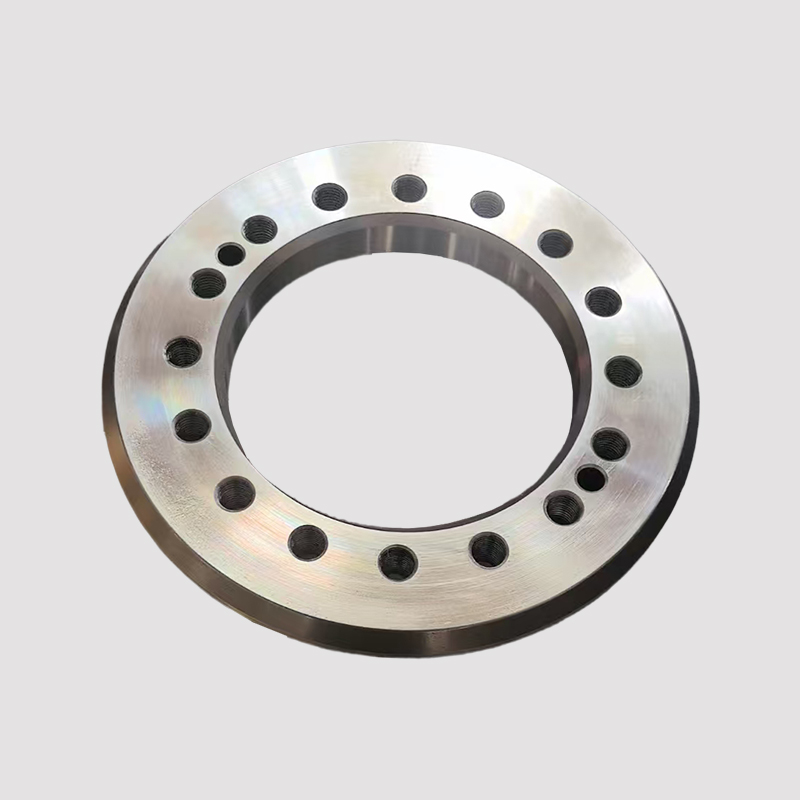
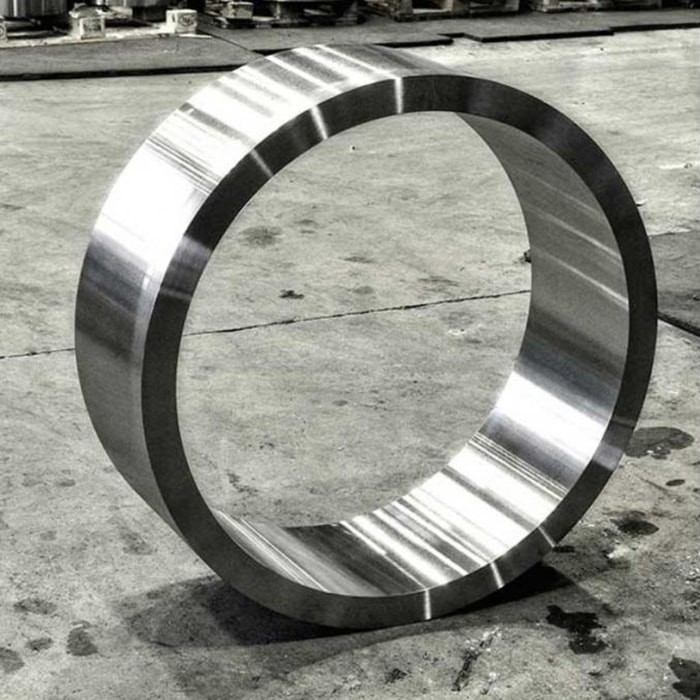
Large diameter forged steel rings, often exceeding a meter or more across, are used in applications like wind turbine flanges, slewing bearing races, pressure vessel components, and large industrial gearboxes, where the ring needs to carry substantial structural or rotational load. Producing rings at this scale requires ring rolling mills with sufficient roll separating force and mandrel capacity, since larger rings demand proportionally greater forging force to achieve the same wall reduction as a smaller ring.
Heavy duty forged steel rings are specified not just by diameter but by cross-sectional thickness and alloy grade suited to high-load service — wind energy and heavy machinery applications in particular call for rings that combine large size with high-strength alloy steel and rigorous heat treatment, since a failure at that scale carries far greater consequences than a smaller component failure.
Custom Forged Steel Rings
Custom forged steel rings are produced to a specific drawing rather than a standard catalog size, with diameter, wall thickness, height, and alloy selected to match the customer's application. Ring rolling's process flexibility makes custom sizing relatively straightforward compared to processes that require dedicated tooling for each dimension — the same mill can roll a wide range of diameters and cross-sections simply by adjusting the preform size and roll settings.
Beyond dimensional customization, custom orders often specify particular mechanical property requirements, non-destructive testing (ultrasonic or magnetic particle inspection), and material certification to match the ring's intended service — details worth confirming with the manufacturer at the quoting stage rather than after production begins.
Forged Steel Rings Heat Treatment
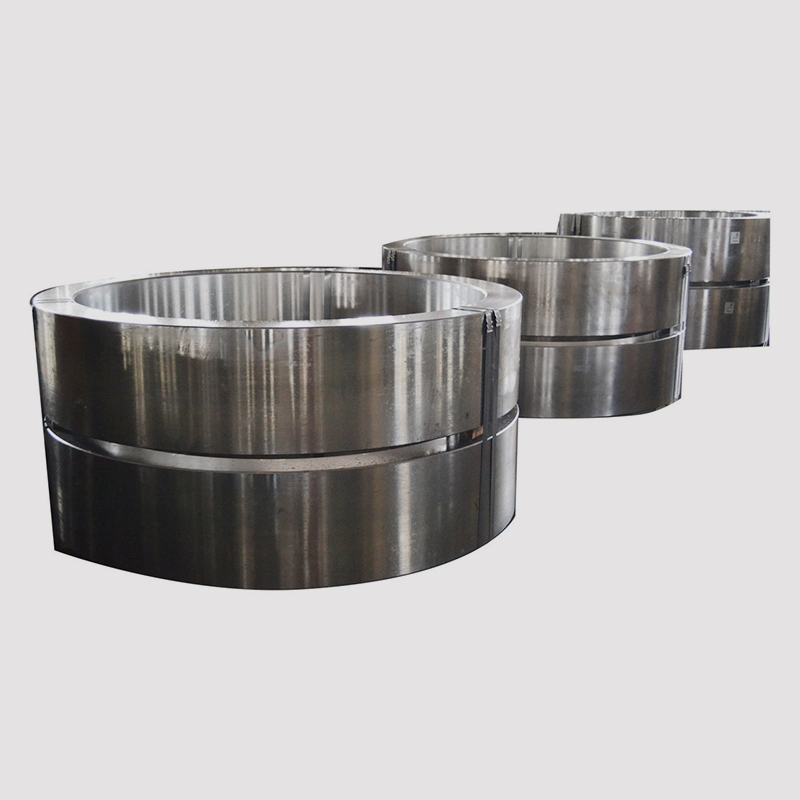
Heat treatment after forging is what develops a ring's final mechanical properties — as-forged material alone typically doesn't meet the strength, toughness, or hardness specification the application requires. Common heat treatment processes for forged steel rings include:
- Normalizing: Heating above the critical temperature followed by air cooling, used to refine grain structure and relieve internal stress from forging.
- Quenching and tempering: Rapid cooling (quenching) to achieve high hardness, followed by reheating to a lower temperature (tempering) to restore toughness and reduce brittleness — the standard treatment for higher-strength alloy steel rings.
- Annealing: Slow, controlled cooling from an elevated temperature, used to soften the material for easier subsequent machining.
- Stress relieving: A lower-temperature treatment focused specifically on reducing residual stress from forging and machining without significantly altering hardness.
Ring geometry adds a practical wrinkle to heat treatment that solid parts don't face: because rings are thin relative to their diameter, uneven heating or cooling can distort roundness, so heat treatment furnaces and quench fixtures for large rings are often designed specifically to support the ring evenly and control temperature uniformity around its circumference.
Alloy Steel Forged Rings
Alloy steel forged rings incorporate elements like chromium, molybdenum, nickel, or vanadium beyond plain carbon steel's composition, improving strength, hardenability, or toughness for demanding applications. Common alloy grades for forged rings include 42CrMo (a chromium-molybdenum steel widely used for gears and high-strength structural rings), 34CrNiMo6 for very high-strength applications like wind turbine main shafts and bearing rings, and various AISI 41xx-series steels for general high-strength forged components.
Grade selection generally comes down to balancing required strength and toughness against cost and machinability — higher-alloy grades cost more and can be more difficult to machine, so specifying more alloy content than the application actually needs adds expense without a corresponding performance benefit.
Precision Forged Steel Rings
Precision forged steel rings are produced to tighter as-forged dimensional tolerances than standard ring rolling typically achieves, reducing the amount of subsequent machining needed to reach final drawing dimensions. This is accomplished through more tightly controlled preform sizing, roll pressure, and process monitoring during the ring rolling operation itself, rather than relying on generous machining stock to correct dimensional variation after forging.
The main benefit of precision forging is material and machining time savings — a ring that comes off the mill closer to its final dimensions requires less material to be removed and less machine time to finish, which matters most on higher-volume programs where that savings compounds across many parts.
Forged Steel Rings for Industrial Applications
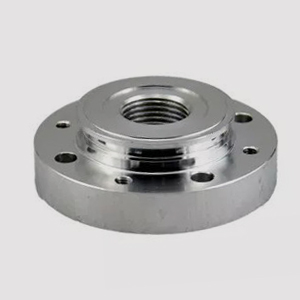
Forged steel rings for industrial applications turn up wherever a rotating or load-bearing component needs a seamless, high-strength circular section — bearing races, gear blanks, flanges, couplings, and structural rings in heavy machinery and industrial gearboxes. The seamless grain flow from ring rolling gives these components fatigue resistance that a welded or plate-cut ring can't match, which matters most in applications with continuous cyclic loading, such as rotating machinery that runs for years without a planned replacement.
Because industrial applications span such a wide range of load and environmental conditions, forged ring specifications for this category vary more than almost any other end use — from mild carbon steel rings for general equipment through high-alloy, precision-toleranced rings for critical rotating machinery.
Forged Steel Rings for the Oil and Gas Industry
Oil and gas applications call on forged steel rings for flanges, wellhead components, valve bodies, and structural connections that need to withstand pressure, temperature extremes, and often sour or corrosive service conditions. As with other oil and gas forgings, material traceability and non-destructive testing — ultrasonic inspection in particular, given the risk of internal defects in a ring subjected to sustained pressure — are standard requirements rather than optional add-ons.
Grade selection for oil and gas ring forgings typically follows API and ASTM specifications matched to the specific pressure class and service environment, with sour-service applications often requiring additional hardness limits under NACE MR0175/ISO 15156 to guard against sulfide stress cracking.
Forged Steel Rings for Pressure Vessels
Pressure vessel applications use forged steel rings for shell courses, flanges, and nozzle reinforcements, where the ring's seamless structure directly supports the vessel's ability to hold internal pressure without a weld seam acting as a stress concentration point. These rings are typically manufactured and certified to codes such as ASME Section VIII, which specify material properties, testing requirements, and documentation the forging must meet before it can be used in a certified pressure vessel.
Because pressure vessel service often combines sustained internal pressure with thermal cycling, forged rings for this application are selected as much for creep resistance and long-term fatigue performance as for headline tensile strength, which is part of why heat treatment and post-forge testing receive close attention in pressure vessel-grade ring specifications.
Forged Steel Rings for Wind Turbines
Wind turbines rely heavily on large-diameter forged steel rings for slewing bearing races, main shaft flanges, tower flanges, and gearbox components — applications where the ring has to handle enormous cyclic loading from decades of rotor movement and wind loading without failure. The scale involved is substantial: main bearing rings on modern utility-scale turbines can exceed two to three meters in diameter, requiring ring rolling mills with the capacity to forge at that size.
Fatigue performance is the dominant design consideration for wind turbine ring forgings, since these components see millions of load cycles over a 20-plus year service life — high-alloy grades like 34CrNiMo6, combined with careful heat treatment and thorough ultrasonic testing to rule out internal defects, are standard practice for this application.
High-Strength Forged Steel Rings
High-strength forged steel rings are specified wherever a component's size or weight needs to be minimized while still carrying substantial load — applications like aerospace structural rings, high-performance gearing, and heavy equipment components where a lower-strength material would require excessive bulk to handle the same load. Achieving high strength in a forged ring comes from a combination of alloy selection (chromium-molybdenum or nickel-chromium-molybdenum steels), controlled forging to maximize favorable grain flow, and precise quench-and-temper heat treatment tuned to the ring's cross-section.
Section thickness matters more for high-strength rings than it does for standard-grade forgings, since achieving full through-thickness hardening during quenching becomes harder as cross-section increases — a ring specified for a certain strength level needs its wall thickness checked against the alloy's hardenability to confirm the target properties are achievable through the full section, not just at the surface.
Carbon Steel vs. Stainless Steel Forged Rings
Carbon steel forged rings cover the large majority of general industrial, structural, and mechanical applications, offering good strength and toughness at a lower material cost than alloy or stainless options — the default choice whenever the service environment isn't corrosive enough to require additional protection. Where higher strength is needed without corrosion resistance being a priority, alloy carbon steels like 42CrMo step in above plain carbon grades.
Stainless steel forged rings are specified when the ring will be exposed to moisture, chemicals, or other corrosive conditions that would degrade carbon steel over time — food and beverage processing equipment, chemical plant components, and marine hardware are common applications. Austenitic grades like 304 and 316 are the most common choices, with 316 preferred wherever chloride exposure is part of the service environment, though stainless comes at a meaningful cost premium over carbon steel and, in some grades, at a strength trade-off unless supplied in a precipitation-hardening or duplex grade.
Forged Steel Ring Material Selection
Selecting the right material for a forged steel ring comes down to weighing four factors against each other rather than optimizing for any single one in isolation: the mechanical load the ring will carry in service, the environment it will operate in, any code or industry specification the application falls under, and the total installed cost once material, forging, and heat treatment are all accounted for.
A practical selection process usually starts by ruling categories in or out — corrosive service rules out plain carbon steel, extreme cyclic loading rules out lower-fatigue-resistance grades — before narrowing within the remaining category based on cost and lead time. Buyers sometimes default to over-specifying material strength "to be safe," but that habit adds cost and can even work against the application if a higher-strength grade sacrifices toughness or weldability the design actually needs.
Forged Steel Rings Mechanical Properties
Forged steel ring specifications are typically reported and verified against five core mechanical properties, each tested from a sample cut from the actual forged ring or an attached prolongation rather than from separately cast test bars:
- Tensile strength: The maximum stress the material can withstand before failure, the baseline figure most specifications reference first.
- Yield strength: The stress at which the material begins to deform permanently, generally the more relevant figure for structural design since most applications need to stay within elastic deformation.
- Elongation: A percentage measure of ductility, indicating how much the material stretches before fracture — important for predicting how a ring behaves under overload rather than failing suddenly and without warning.
- Impact toughness: Measured via Charpy testing, this indicates how the material absorbs sudden shock loading, particularly important at low temperatures where steel can become more brittle.
- Hardness: Often measured as a quick, non-destructive proxy for tensile strength, and also relevant on its own for wear resistance in applications like bearing races.
Forged Steel Rings Quality Standards
Forged steel rings are typically produced and certified against a combination of material standards (which define chemical composition and mechanical property requirements for a given grade) and process or industry-specific standards (which govern how the forging is produced, tested, and documented for a particular application). ASTM specifications such as A105 and A350 cover carbon and low-alloy steel forgings broadly, while EN 10250 and EN 10222 serve the equivalent role in European specifications.
On top of material standards, many industries layer their own qualification requirements — pressure equipment codes, offshore and marine classification society rules, or customer-specific quality manuals — that dictate additional testing, documentation, and traceability beyond the base material specification. Confirming which standards actually apply to a project before forging begins avoids the far more expensive scenario of re-testing or re-certifying rings after the fact.
Forged Steel Rings Dimensional Inspection
Dimensional inspection of a forged ring checks outer diameter, inner diameter, wall thickness, height, and roundness (out-of-round deviation) against the drawing tolerance, since ring rolling — even well-controlled — produces some natural dimensional variation that needs to be verified before the ring moves to the next production step. Basic checks use calipers and micrometers for spot measurements, while tighter-tolerance or complex-profile rings are increasingly measured with coordinate measuring machines (CMM) or laser scanning for a full dimensional map rather than a handful of point checks.
Roundness deserves particular attention on large rings, since a ring can meet diameter and wall thickness tolerances at individual measurement points while still being out of round overall — a distortion that matters significantly for rings destined for precision bearing or gear applications where mating parts need consistent clearance all the way around the circumference.
Forged Steel Rings Surface Treatment
Surface treatment on a forged steel ring bridges the gap between the as-forged or as-machined surface and whatever condition the ring needs to be in for storage, assembly, or final service. Shot blasting is a common first step, removing forging scale and preparing a clean, uniform surface for subsequent inspection or coating. From there, treatment options vary by application: a rust-preventative oil coating for rings headed into short-term storage before machining, phosphate coating to improve paint adhesion or provide temporary corrosion protection, or a final protective coating (paint, zinc, or specialty coatings) for rings that will see long-term outdoor or corrosive exposure in service.
For rings with critical mating surfaces — bearing races or precision-machined bores, for example — surface finish specification (measured as roughness average) becomes as important as the coating itself, since a surface that's too rough can accelerate wear on a mating component even if the underlying dimensional tolerance is correct.
Forged Steel Rings vs. Cast Steel Rings
Cast steel rings are produced by pouring molten steel into a mold shaped to the ring's geometry, which allows more complex integral shapes in a single step but leaves the material with a coarser, less directional grain structure than a forged ring — and carries a higher risk of internal porosity or shrinkage voids from the solidification process. Forging, by contrast, works the steel mechanically, compressing and refining the grain structure and closing up internal defects that might be present in the starting billet.
The practical result is that forged rings generally outperform cast rings of the same alloy on fatigue resistance and impact toughness, which is why forging is preferred for rings under significant cyclic or shock loading, while casting can be more cost-effective for complex geometries or lower-load applications where those mechanical advantages matter less.
Forged Steel Rings vs. Rolled Steel Rings
The term "rolled steel ring" sometimes causes confusion, since ring rolling is itself part of the forging process — but in a comparative sense, a "rolled" ring most often refers to a ring rolled or bent from flat plate or bar stock and then welded closed, rather than a solid billet worked through the upsetting, piercing, and rolling sequence used to produce a true forged ring. That distinction matters mechanically: a plate-rolled-and-welded ring has a weld seam that interrupts the material's grain continuity, creating a localized point that typically has different mechanical properties than the surrounding parent material.
For lower-stress applications or larger-diameter rings where seamless ring rolling capacity is limited, a rolled-and-welded ring can be a practical and more economical option. For higher-load, fatigue-critical, or pressure-retaining applications, a true forged ring's seamless structure is generally worth the additional cost, since it removes the weld seam as a potential failure initiation point entirely.
Oversized Forged Steel Rings
Beyond the forging challenge itself, oversized rings introduce logistics considerations that smaller forgings don't face — specialized heat treatment furnaces large enough to accommodate the ring evenly, cranes and rigging rated for the finished weight, and transport arrangements (often requiring oversize load permits and route planning) to move the ring from the forge shop to its final destination. Planning for these logistics early in a project, rather than after the ring is forged, avoids the scenario where a technically successful forging sits waiting for transport or handling equipment to catch up.
Not every forge shop has the mill capacity, furnace size, or crane capacity to handle oversized rings, so confirming a supplier's actual equipment limits against the project's specific dimensions and weight — rather than their general size range — is worth doing before committing to an oversized ring order.
Engineered Forged Steel Rings
An engineered forged steel ring goes beyond matching a submitted drawing — it involves the forge shop's engineering input on ring cross-section, material grade, and forging sequence to optimize the part for its actual load case, rather than simply producing whatever geometry was specified. This kind of collaboration is most valuable early in a project, when the ring's cross-sectional profile, fillet radii, and grain flow orientation can still be adjusted to better align with the anticipated stress distribution in service.
Engineering input matters most on rings where failure consequences are high or where weight reduction has real value — aerospace, energy, and heavy machinery applications where a forge shop's process expertise can meaningfully improve on a generic design, versus a straightforward commodity ring where the standard rolling process is already the right fit.