

 English
 русский
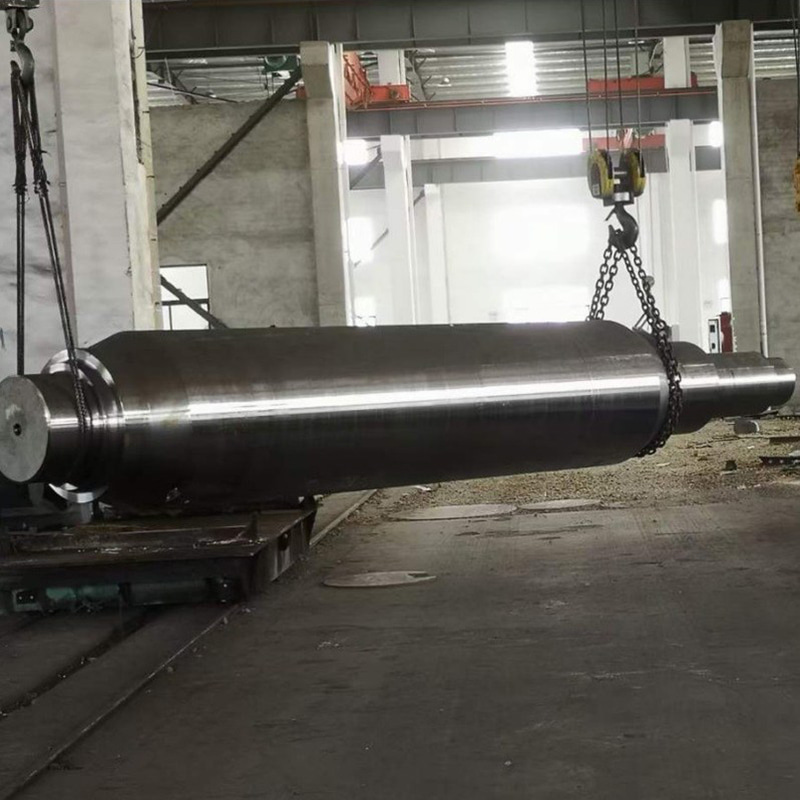
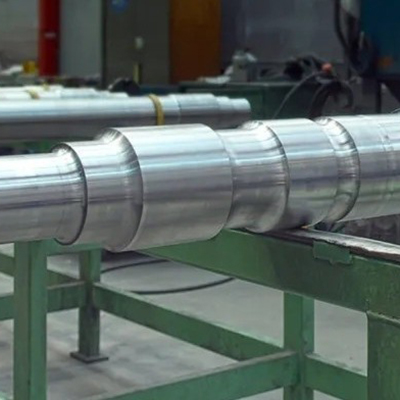
For most industrial power transmission and linear motion applications, a 1045 medium carbon steel shaft with induction-hardened surface hardness of 55 HRC and an h6 diameter tolerance delivers the optimal balance of strength, wear resistance, and cost. A 25 mm shaft produced to this specification transmits a continuous torque of 210 Nm, maintains a straightness of 0.05 mm per meter, and typically runs in ball bearings for over 20,000 hours before the diameter wear exceeds 0.01 mm.
Material Selection and Mechanical Properties
The base material determines the shaft's strength, machinability, and response to heat treatment. The table below compares the three most widely specified round steel shaft materials in the as-supplied and heat-treated conditions.
| Material | Yield Strength (MPa) | Tensile Strength (MPa) | Typical Surface Hardness |
|---|---|---|---|
| AISI 1045 (quenched & tempered) | 530 | 630 | 55-60 HRC (induction hardened) |
| AISI 4140 (hardened & tempered) | 800 | 1000 | 58-62 HRC (nitrided) |
| AISI 304 Stainless | 205 | 520 | 85 HRB (work hardens only) |
1045 provides the best combination of strength and cost for standard motor and pump shafts. 4140 is chosen when higher core strength or nitriding is required for heavy shock loads. 304 stainless is limited to food-grade or corrosive environments where a non-magnetic shaft with a yield strength below 250 MPa is acceptable.
Diameter and Straightness Tolerances
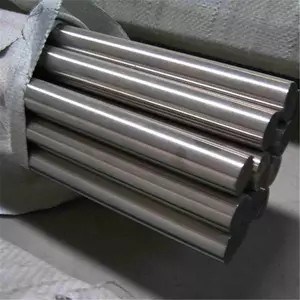
The tolerance grade on the shaft diameter directly controls bearing fit and runout. The most common tolerance grades for rotating shafts and their actual limits for a nominal diameter of 20 mm are as follows.
- h6: diameter range 20.000 mm to 19.987 mm. This precision grade ensures a light press fit with a P6 bearing inner ring and maintains a running accuracy of 0.005 mm TIR.
- h7: diameter range 20.000 mm to 19.979 mm. Used where a slip fit with a slight radial clearance is acceptable, such as on conveyor idler rollers.
- f7: diameter range 19.980 mm to 19.959 mm. Provides a guaranteed clearance of 0.020 mm to 0.041 mm for applications requiring axial sliding or thermal expansion compensation.
Straightness is equally critical. A standard round steel shaft up to 1 meter long is typically supplied with a straightness of 0.05 mm per meter. At 2 meters, the total permissible runout doubles to 0.10 mm. A shaft with a straightness error beyond 0.15 mm per meter induces vibration levels that reduce the L10 bearing life by a factor of 40%.
Heat Treatment and Hardened Case Depth
Heat treatment builds a hard, wear-resistant surface while retaining a tough core. Induction hardening is the dominant process for medium-carbon shafts.
Induction Hardening Parameters
A 1045 shaft is heated by a high-frequency coil and immediately quenched. The case depth achieved is a function of frequency and time. A frequency of 10 kHz and a scan speed of 3 mm per second produce a hardened layer 1.5 to 2.0 mm deep with a surface hardness of 55 to 60 HRC. The core remains at 25 to 30 HRC, providing high ductility and resistance to fatigue crack propagation.
Through-Hardening Versus Case Hardening
Through-hardened 4140 shafts are quenched and tempered to a uniform hardness of 28-32 HRC. This gives a yield strength above 700 MPa throughout the cross-section. For extreme wear, case-hardened low-carbon steel shafts (e.g., 20MnCr5) are carburized to a surface carbon content of 0.8% and hardened to 60-62 HRC with a case depth of 0.8-1.2 mm.
Surface Finishing and Corrosion Protection
The shaft surface finish directly affects seal life and friction. A ground finish of Ra 0.4 to 0.8 µm is standard for bearing seats. For rotary shaft seals, a finish of Ra 0.2 to 0.4 µm with a lay perpendicular to the direction of rotation prevents leakage. A single plunge-ground shaft meeting Ra 0.2 µm extended the seal life from 3,000 hours to over 8,000 hours in a gearbox test.
Corrosion protection is added when shafts are exposed to humidity or chemicals. The most effective options are:
- Hard chrome plating with a thickness of 20-50 µm and a hardness of 850-1000 HV. It resists 96-hour salt spray without red rust and is regrindable.
- Electroless nickel plating provides a uniform 10-25 µm coating that does not alter the fatigue strength. It is preferred for complex shafts because of its even deposit profile.
- Black oxide offers minimal corrosion protection (less than 24 hours salt spray resistance) but provides a decorative finish and retains oil for short-term storage.
Load Capacity and Application-Specific Design
The torque capacity of a round steel shaft is calculated from the shear yield strength. For a 1045 shaft with a yield strength of 530 MPa and a diameter of 30 mm, the fully reversible torque capacity according to the maximum shear stress theory is 450 Nm. When a keyway is added, the torque capacity drops by approximately 25% due to the stress concentration factor of 2.5 at the keyway corner.
For linear motion shafts in ball bushing systems, the surface hardness must be at least 58 HRC to prevent brinelling under the ball contact stress, which can exceed 2,500 MPa. An induction-hardened 1045 shaft with a minimum case depth of 1.5 mm meets this requirement, whereas an unhardened shaft will show a wear groove within 1,000 km of travel.
Installation Fits and Bearing Assembly
The correct shaft-to-bearing fit prevents fretting corrosion and maintains the internal bearing clearance. The recommended fits for standard applications are as follows.
- For rotating shaft with stationary housing: shaft tolerance j6 for light loads, k6 for normal loads, and m6 for heavy shock loads. An m6 fit on a 25 mm shaft provides an interference of 0.008 mm to 0.025 mm.
- For a stationary shaft with rotating housing: shaft tolerance g6 or h6 is used to allow axial adjustment while maintaining radial location.
- Always heat the bearing inner ring to 80-100 degrees C using an induction heater before sliding it onto the shaft. Cold pressing without heating can score the shaft journal and reduce the interference grip by 15%.